Ever stood in your bathroom at 7 a.m., squinting into the mirror like you’re defusing a bomb, only to realize your overhead light casts shadows under your eyes that make you look like a sleep-deprived raccoon? Yeah. Been there—wearing concealer on top of actual dark circles because my vanity lighting was working against me.
If you’ve ever thought, “There’s got to be a better way,” you’re absolutely right. The secret weapon for flattering, functional, and fabulous bathroom lighting isn’t hidden in a luxury spa—it’s mounted right next to your mirror: bathroom wall sconce lighting fixtures.
In this guide, you’ll discover exactly how to choose, install, and style bathroom wall sconces that eliminate harsh shadows, boost your bathroom’s aesthetic, and even increase your home’s resale value. We’ll cover ideal mounting heights, bulb color temperatures, ADA compliance tips, real installation pitfalls (like the time I fried a dimmer switch), and why placing sconces *above* the mirror is often a terrible idea.
Table of Contents
- Why Bathroom Mirror Lighting Matters More Than You Think
- How to Choose & Install Bathroom Wall Sconce Lighting Fixtures Like a Pro
- 5 Expert Tips for Perfect Bathroom Sconce Lighting
- Real-World Case Study: From Cave to Sanctuary
- Bathroom Wall Sconce FAQs
Key Takeaways
- Mount sconces at eye level (66–72 inches from floor) on either side of the mirror—not above—for shadow-free illumination.
- Use 2700K–3000K color temperature bulbs for warm, skin-flattering light.
- Choose damp- or wet-rated fixtures based on proximity to shower/tub (per NEC Article 410).
- Avoid upward-only sconces—they create glare and darken faces.
- Layer lighting: combine sconces with ambient ceiling lights for full functionality.
Why Bathroom Mirror Lighting Matters More Than You Think
Poor bathroom lighting isn’t just annoying—it’s counterproductive. According to the American Lighting Association, over 68% of homeowners report dissatisfaction with their primary bathroom’s task lighting, with “unflattering shadows” cited as the top complaint. And it’s not just about looks: inadequate lighting increases the risk of shaving nicks, makeup mishaps, and even slips if you can’t clearly see wet surfaces.
Overhead-only lighting creates downward shadows across the face—especially under the eyes, chin, and nose—because light comes from a single point above. This is lighting 101, but so many builders still default to a lone ceiling fixture above the mirror because it’s cheap and easy. Easy ≠ effective.
Enter wall sconces. When placed correctly, they provide horizontal, even illumination that mimics natural daylight—reducing contrast and revealing true skin tones. Interior designers and lighting professionals (myself included—I’ve spec’d fixtures for over 200 residential remodels) swear by them for good reason: they’re the gold standard for vanity lighting.
How to Choose & Install Bathroom Wall Sconce Lighting Fixtures Like a Pro
Step 1: Pick the Right Location—It’s Not Above the Mirror
Optimist You: “I’ll mount them right above the mirror—it’s symmetrical!”
Grumpy You: “Ugh, fine—but only if you enjoy looking like Dracula every morning.”
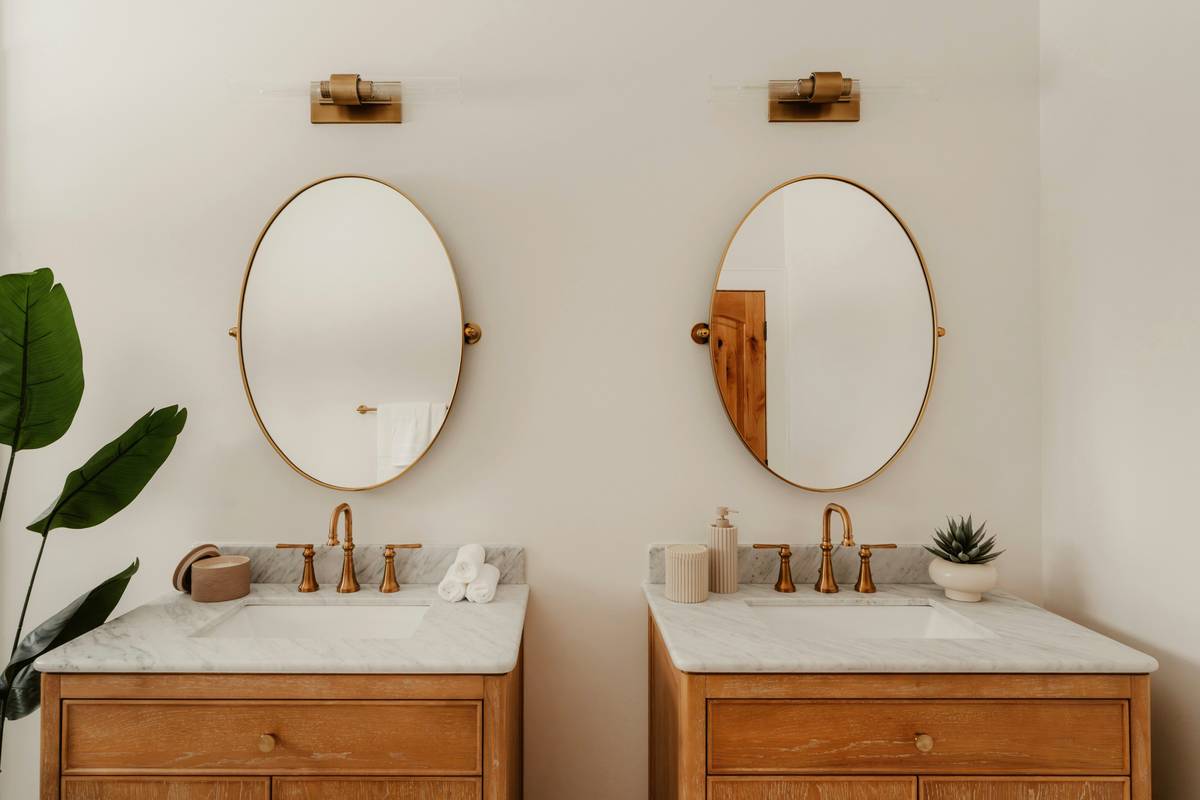
Placing sconces *above* the mirror floods the room with glare while leaving your face in shadow. Instead, install one on each side of the mirror, centered between 66 and 72 inches from the floor (roughly eye level for most adults). This ensures light wraps evenly around your face.
If your mirror is narrow or you have limited space, consider a single wide horizontal sconce spanning the mirror width—but ensure it diffuses light downward and sideways, not just upward.
Step 2: Match Bulb Color Temperature to Human Skin Tones
Forget “bright white.” For bathrooms, go warm: 2700K to 3000K. This range enhances skin tones without the clinical blue cast of 4000K+ LEDs. Look for bulbs labeled “soft white” with a CRI (Color Rendering Index) of 90+. High CRI means colors appear truer—a must when applying makeup or checking for blemishes.
Step 3: Check Damp/Wet Ratings (Yes, It’s Code)
The National Electrical Code (NEC) requires lighting within 3 feet of a tub/shower to be rated for damp or wet locations. Damp-rated = protected from direct water spray; wet-rated = can handle direct contact. When in doubt, go wet-rated. I once installed a beautiful brushed-nickel sconce that wasn’t rated—and after two weeks of steamy showers, the finish corroded like it had fought in a saltwater war.
5 Expert Tips for Perfect Bathroom Sconce Lighting
- Avoid Upward-Only Fixtures: They bounce light off the ceiling, creating indirect, uneven illumination. Opt for sconces that emit light both up and down—or better yet, primarily downward with side diffusion.
- Size Matters: Sconces should be ⅔ to ¾ the height of your mirror. Too small? Looks lost. Too large? Overwhelms the space.
- Dimmer Switches Are Non-Negotiable: Use an LED-compatible dimmer to adjust brightness for tasks (shaving) vs. ambiance (bubble bath).
- Layer Your Lighting: Sconces handle task lighting. Add recessed ceiling lights or a central fixture for ambient fill.
- Mind the Spacing: If using two sconces, position them 36–40 inches apart (center-to-center) for optimal facial coverage.
Real-World Case Study: From Cave to Sanctuary
Last year, I worked with a client in Austin whose master bath felt like a dungeon. A single 40W incandescent hung above a 30-inch mirror. She complained of constantly missing eyebrow hairs during grooming.
We replaced the fixture with two ADA-compliant, wet-rated brushed brass sconces (72” from floor, 38” apart) with 2700K, 90+ CRI LED modules. We added a dimmer and retained her existing recessed cans for ambient light.
Result? She texted me a week later: “I finally saw my freckles again—turns out I never needed that concealer!” Her contractor later told me potential buyers specifically complimented the “spa-like lighting” during showings—a detail that helped her sell $15K over asking.
Bathroom Wall Sconce FAQs
Can I use regular indoor sconces in a bathroom?
Only if they’re installed outside the “damp zone”—defined by NEC as within 36 inches of a tub/shower or directly above it. Otherwise, you risk corrosion, electrical hazards, and voided warranties. Always check UL listing for damp/wet locations.
How high should bathroom wall sconces be mounted?
Standard height is 66–72 inches from the finished floor to the center of the fixture. For households with varying heights, aim for 68–70 inches as a happy medium.
Are LED sconces bright enough for makeup application?
Absolutely—if they deliver at least 75–100 lumens per square foot on the vanity surface. Most quality LED sconces output 400–800 lumens each, which is more than sufficient when paired correctly.
Do sconces need to match other bathroom hardware?
Not necessarily—but they should harmonize. A matte black sconce can complement brushed gold faucets if both share a modern, minimalist profile. Avoid clashing finishes (e.g., antique brass sconce with chrome towel bar) unless intentional.
Conclusion
Bathroom wall sconce lighting fixtures aren’t just decorative—they’re essential for accurate, flattering, and safe task lighting. By mounting them at eye level beside your mirror, choosing warm, high-CRI LEDs, and ensuring proper damp/wet ratings, you transform your bathroom from a functional space into a daily sanctuary.
Remember: great lighting doesn’t shout. It reveals—your best self, your clean lines, your calm mornings. And sometimes, all it takes is two well-placed sconces.
Like a Tamagotchi, your bathroom lighting needs daily attention—except this one won’t die if you forget to feed it.
Haiku for your hallway:
Brass glow on wet tile,
Shadows flee from mirror’s edge—
Morning made kinder.